
Architects, engineers and designers looking to upskill usually face two kinds of product: broad platforms offering short masterclasses across many disciplines, and a cohort-based BIM course that follows one discipline path in depth. The choice is really between breadth and depth, and this guide sets out how to make it deliberately. The AECIX academy catalogue sits firmly on the depth side of that choice. Course structures change, so treat everything here as a framework for your own checks rather than a specification, and confirm details with any provider directly before deciding.
Key Takeaways
Breadth platforms and depth programmes solve different problems. Exploration is a real need and so is employability, but one purchase rarely serves both well. Short masterclasses are excellent for deciding a direction and insufficient for changing what you are employable as. If you already know your destination role, catalogue depth and stated prerequisites matter far more than the number of disciplines a platform covers.
Breadth and Depth: Two Genuinely Different Products
A broad upskilling platform covers many disciplines with short courses and masterclasses. Its value is optionality. You can sample architecture, engineering, interior and interface work cheaply, discover what interests you, and commit later with better information than you had at the start. A depth programme covers one discipline path through sequenced levels with prerequisites. Its value is that it produces a specific capability and a specific artefact at the end. It is a worse purchase for exploration and a better one for employability. Neither is a compromised version of the other. They are answers to different questions, and the mistake is buying one while needing the other rather than either being poorly built. The useful first step is therefore to work out which question you are actually asking. If you cannot name a destination role, you are exploring, and a breadth platform is genuinely the right purchase. If you can, exploration is no longer what you need to buy. A quick test if that is unclear: could you write down, in one sentence, the job title you want to hold in two years? If yes, you are in the depth phase. If the honest answer is something in architecture or engineering, you are still exploring, and buying a long programme now will simply postpone the decision at greater expense.
What a Masterclass Can and Cannot Do
A one day masterclass is a superb instrument for a specific job. It shows you what a discipline feels like from the inside, tells you whether the work interests you, and does it in an afternoon for very little money. Nothing else provides that at that cost. What it cannot do is make you employable in the subject, and honest providers say so. Capability comes from sustained practice with correction over weeks, not from exposure over hours, and no format compresses that beyond a certain point. The failure mode is accumulation. A profile listing eight masterclasses across four disciplines reads as indecision to an interviewer rather than as breadth, because it demonstrates exposure without depth in any direction. Two or three used deliberately to decide a path is entirely different from eight collected as reassurance. Used well, a masterclass is a decision instrument that precedes a depth programme. Used badly it substitutes for one, and the substitution is only discovered at the point of applying for roles. There is a reasonable middle path: take short sessions across two or three candidate directions and then stop. Set the number in advance rather than deciding as you go, because the decision to sample one more is always locally reasonable and collectively how people spend a year deciding.
What Depth in BIM Training Actually Requires
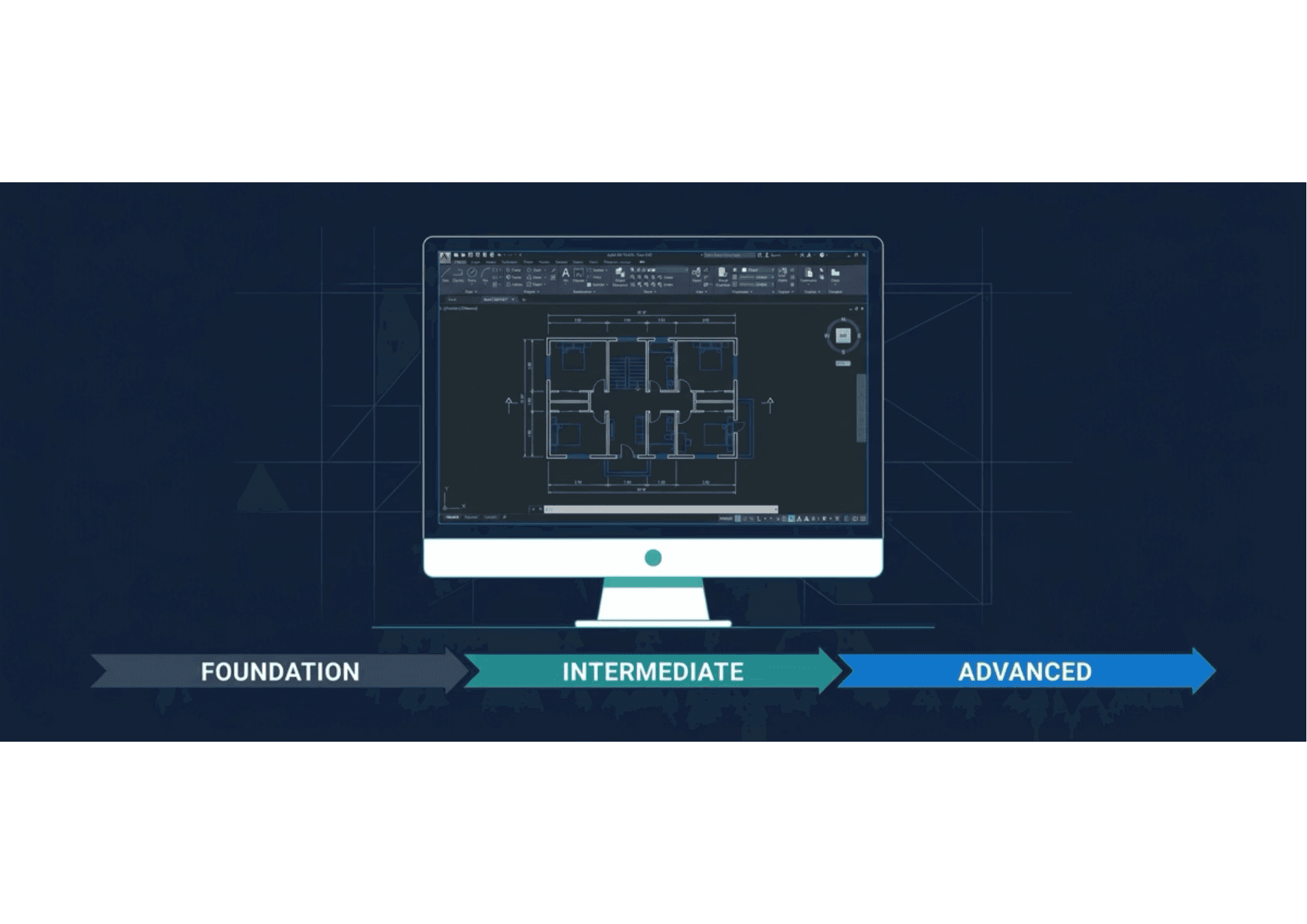
Sequenced levels with real prerequisites come first. Depth means each stage assumes the previous one, which means a provider has to be willing to tell some applicants they are not ready. That willingness is commercially costly and is the clearest structural sign of a depth programme. AECIX organises its course levels this way. Foundation covers BIM Fundamentals and AutoCAD Essentials, professional covers the Revit tracks, specialist covers Navisworks, Navisworks Manage and ISO 19650. The levels are not marketing labels; they gate what you can enrol in. Reviewed work is the second requirement. Depth without correction produces confident bad habits, because a model can open cleanly and still be built in a way that fails when a coordinator links it. Somebody has to open the file, and that is the most expensive thing a provider can offer. A route beyond the first course is the third. Depth is a path rather than a purchase, and a catalogue that ends where your first course does leaves you making the same decision again in six months with no more information than you had before. These three requirements are commercially costly in the same direction, which is why they cluster. Gating enrolment shrinks the market, reviewing files raises delivery cost, and maintaining a full catalogue is more expensive than selling one popular course. A provider carrying all three has structured the business around outcomes rather than volume, and that is a reasonable thing to pay for.
Why a Cohort-Based BIM Course Improves Completion
Live cohort) delivery converts the deadline into a social fact. The session runs on its scheduled day whether or not you prepared, and work is due whether or not the week was difficult. That external structure is doing far more work than most learners expect. Self paced study fails for structural rather than motivational reasons. Without an external deadline, study competes weekly against work and family and loses most of those contests, which is why abandonment rates for unstructured content are what they are. The peer effect follows from the same structure. Seeing three other solutions to the exercise you just completed teaches the decision space rather than one path through it, and the group becomes a professional network in related roles within a few years of finishing. AECIX runs live cohorts scheduled around work and study commitments, with fixed intake dates. The fixed start is the feature rather than the inconvenience, because rolling enrolment removes exactly the deadline that makes completion likely. None of this makes cohorts universally correct. They are less flexible, they cost more to run and therefore to buy, and for somebody who genuinely only needs one feature explained they are simply the wrong instrument. The format is right when what you are buying is a change in employability rather than a piece of information.
How to Choose the Right Format for Your Situation
If you cannot yet name a destination role, buy breadth. Sample cheaply, decide, and treat the money as the cost of information rather than of capability. Nobody should sell you a twelve week cohort to answer a question a one day session answers better. If you can name the role, buy depth and stop sampling. The most expensive mistake at this stage is continuing to explore after the decision has effectively been made, because it consumes the months in which a first relevant job should have been found. If you are working full time, weight schedule compatibility above everything else whichever you choose, because a programme you cannot attend teaches nothing however well it is built. And if you are genuinely uncertain, that is a conversation rather than a purchase. An academic counsellor should narrow your options rather than widen them, and a recommendation that expands to fill the call is a sales pattern rather than advice.
Conclusion
Short masterclasses and a cohort-based BIM course are different products for different moments, and the mistake is buying one while needing the other. Sample cheaply while you are deciding, then commit to a sequenced path with prerequisites, reviewed work and a route beyond the first course once you know the destination. That is the point at which the AECIX course catalogue starts to make sense.
FAQ
Q1: Should I choose a broad platform or a specialised BIM programme?
Broad if you cannot yet name a destination role, because exploration is a genuine need. Specialised once you can, because continuing to sample after the decision is made consumes the months a first relevant job should have filled.
Q2: Are short masterclasses worth taking?
Yes, as decision instruments. They show what a discipline feels like from the inside for very little money. They cannot make you employable in it, because capability comes from sustained practice with correction over weeks.
Q3: How many masterclasses is too many?
Beyond two or three used deliberately to decide a direction, they start reading as indecision to an interviewer rather than as breadth, because the profile demonstrates exposure across disciplines without depth in any of them.
Q4: What makes a programme a depth programme?
Sequenced levels with prerequisites that genuinely gate enrolment, work reviewed by a named person, and a defined route beyond the first course. All three are commercially costly to provide, which is exactly what makes them reliable signals.
Q5: Why do cohorts have better completion rates?
Because the deadline becomes a social fact rather than a personal intention. Self paced study competes weekly against work and family and loses most of those contests, which is structural rather than a failure of motivation.
Q6: Do fixed intake dates make things inconvenient?
Slightly, and that inconvenience is the feature rather than a flaw. Rolling enrolment removes the external deadline, and that deadline is the largest structural advantage a cohort holds over studying identical material entirely on your own.
Q7: Can I use both formats?
Yes, and in that order. Sample with short sessions while deciding a direction, then commit to a sequenced programme once the destination is clear. The mistake is running the two in parallel indefinitely without ever deciding.
Q8: Where can I see how AECIX sequences its levels?
The signature programmes page covers the two specialised tracks that sit outside the catalogue, and the AECIX blog hub explains how the foundation, professional and specialist levels build on each other and what each one assumes.