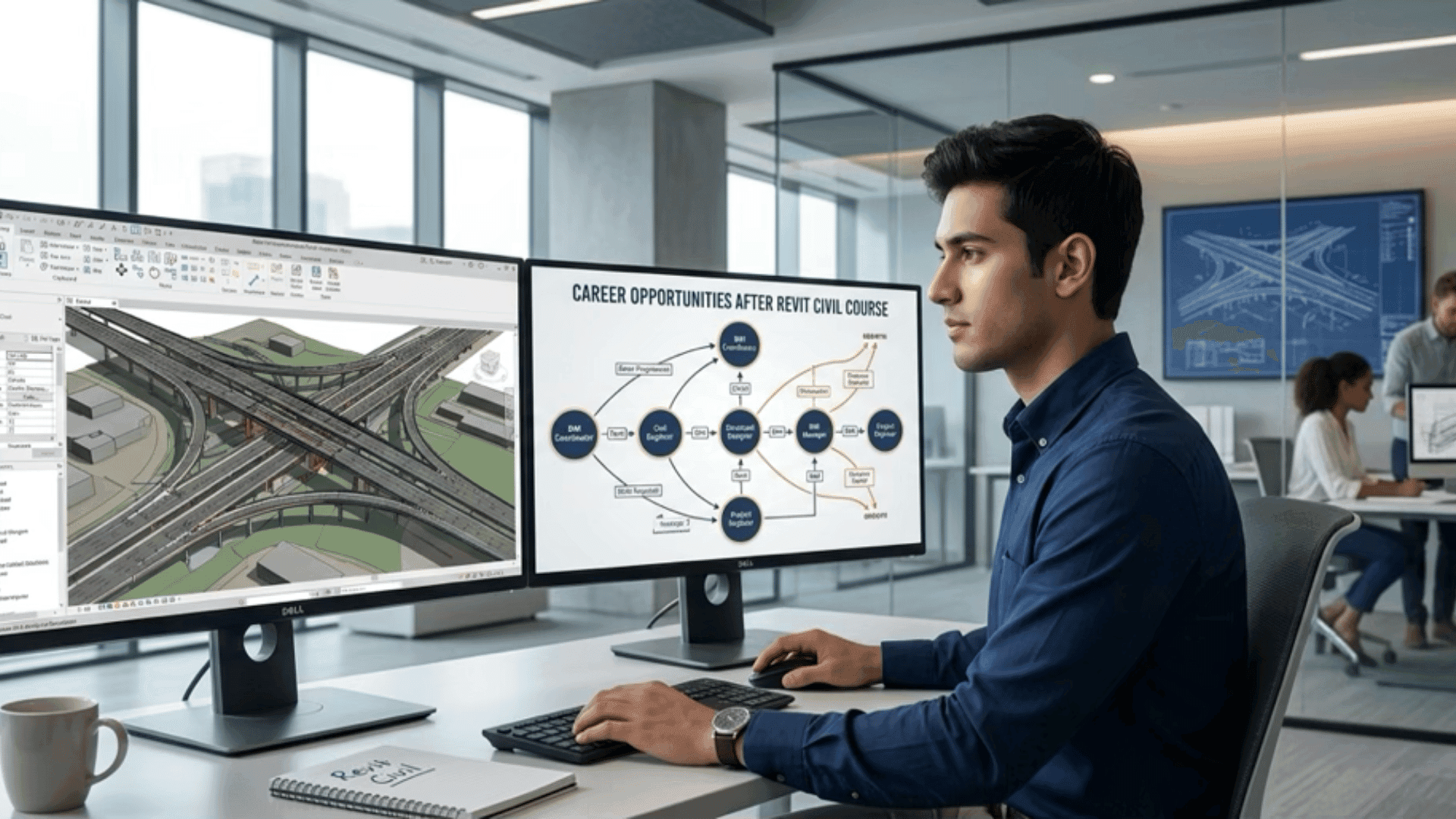
A Revit civil course can be the turning point in your AEC career. As the construction and infrastructure industry shifts toward digital workflows, employers are actively seeking professionals who can model, coordinate, and manage BIM-based projects. Whether you are a fresh civil engineering graduate or a working professional looking to upskill, completing a structured Revit civil course equips you with the technical fluency that today's project teams demand. This blog explores the career paths available, the roles you can target, and how structured BIM learning programmes are preparing the next generation of AEC professionals.
Key Takeaways
Completing a Revit civil course opens roles in BIM coordination, structural modelling, infrastructure design, and digital project delivery. Taking a revit course online allows working professionals and students to build job-ready BIM skills without disrupting their schedule. India's AEC sector is rapidly adopting BIM mandates, creating strong demand for Revit-trained professionals in both domestic and international markets.
Why a Revit Civil Course Matters in Today's AEC Industry
The construction industry is undergoing a fundamental digital transformation. Building Information Modelling has moved from a differentiator to a baseline requirement on large infrastructure and commercial projects. Revit civil course training gives you the technical language to participate in this transformation from day one. According to Autodesk, Revit is one of the most widely adopted BIM authoring tools across structural engineering and infrastructure disciplines. Firms hiring for BIM-related roles consistently list Revit proficiency as a non-negotiable requirement, particularly for entry-level and mid-level positions in India. When you complete a Revit civil course, you gain hands-on experience with real-world workflows including structural family creation, 3D coordination, documentation standards, and federated model management. These are precisely the skills that bridge the gap between academic training and industry expectations.
Top Career Roles Available After a Revit Civil Course
One of the biggest questions graduates ask is: 'Which specific roles can I apply for after completing a Revit civil course?' The answer spans several disciplines within AEC. BIM Modeler is often the first career destination for Revit-trained civil professionals. In this role, you create and maintain 3D information models for structural and infrastructure projects, working within a BIM execution plan, following ISO 19650 naming conventions, and contributing to federated models that the entire project team relies on. Structural Design Technician translates engineer-approved designs into detailed 3D models and construction documents, producing reinforcement layouts, section drawings, and elevation sheets directly from the Revit model. After accumulating experience as a modeler, many professionals progress to BIM Coordinator roles, managing the clash detection process, facilitating inter-discipline coordination meetings, and ensuring model quality across structural, architectural, and MEP packages. Infrastructure Design Specialist positions focus on highways, railways, and water treatment facilities, where you will model terrain, utilities, and civil structures within a coordinated project environment. Digital Project Delivery Specialist roles involve overseeing BIM standards compliance, managing common data environments, and supporting handover deliverables to clients and facility managers.
How a Revit Course Online Expands Your Access to Opportunities
Choosing to take a revit course online removes geographic and scheduling barriers that would otherwise limit your learning options. For students in tier-2 and tier-3 cities across India, live online cohort programmes offer the same quality of instruction as in-person training without relocation costs. Online learning also means you can complete your revit course online while finishing your final year of engineering or while working a part-time role. Cohort-based programmes bring an additional layer of peer accountability, live mentor interaction, and structured project work that self-paced video platforms cannot replicate. The result is a more job-ready graduate who has worked through real AEC scenarios, received mentor feedback, and built a portfolio that employers can evaluate. India's BIM adoption is accelerating, driven by government-backed infrastructure programmes and smart city initiatives. The scale of project investment underway across the country means that BIM-skilled professionals are needed at every tier of the supply chain to deliver these projects digitally.
Industries and Sectors That Hire Revit Civil Graduates
After completing a Revit civil course, your job search does not have to be limited to traditional construction companies. The scope of hiring is broad. EPC Contractors run large multi-discipline BIM projects and require Revit-trained professionals for both modelling and coordination roles. Structural Consultancies are integrating Revit into their documentation workflows. Infrastructure Developers, including highway authorities, port trusts, and railway project offices, are beginning to mandate BIM on major capital works. Real Estate Developers use Revit for design coordination before construction begins. BIM Service Providers that deliver modelling and coordination services to international clients hire Revit-skilled engineers from India. Government Agencies, such as public works departments and urban development authorities adopting BIM mandates, are beginning to recruit or retrain staff with Revit proficiency.
Building a Competitive Profile After Your Revit Civil Course
Completing a Revit civil course is your starting point, not your finish line. Employers want to see that you can apply your skills to realistic project scenarios, not just demonstrate software familiarity. Building a portfolio of modelled projects is the single most effective thing you can do after finishing your training. Include a variety of deliverables such as structural models, coordination clash reports, and extracted schedules. Pair your Revit skills with knowledge of ISO 19650 BIM standards, Navisworks for clash detection, and common data environment platforms. Understanding how Revit sits within a broader BIM ecosystem makes you a far more attractive candidate. The best structured programmes integrate these elements into their curriculum, ensuring that learners graduate with both technical and process-level competence.
Salary Expectations for Revit Civil Professionals in India
Entry-level professionals in India typically earn a competitive starting salary depending on city, firm size, and the complexity of projects handled. BIM Coordinators with several years of experience can command significantly higher compensation. Professionals working for BIM outsourcing firms serving international clients often earn at the higher end of domestic ranges due to project complexity and client expectations. Salaries are not guaranteed outcomes and vary widely based on individual performance, employer, and market conditions. However, the directional trend is clear: BIM skills built on a solid Revit civil course foundation consistently improve employability and earning potential for civil and structural professionals in India.
Conclusion
Completing a Revit civil course is one of the smartest career investments a civil or structural engineering professional can make right now. The construction industry's move toward digital project delivery is creating sustained demand for BIM-skilled professionals across every sector. From Structural Design Technician to BIM Coordinator and Digital Project Delivery Specialist, the career paths available are both varied and rewarding. If you are ready to take that step, a structured, mentor-led programme can prepare you for the industry. Reach out to a reputable BIM training provider to understand which pathway fits your background and goals best.
FAQ
Q1: What jobs can I get after completing a Revit civil course?
After completing a Revit civil course, you can apply for roles such as Structural Design Technician, BIM Coordinator, Infrastructure Design Specialist, and Digital Project Delivery Specialist across EPC firms, consultancies, and BIM service providers in India.
Q2: Is a revit course online as effective as in-person training?
A well-structured revit course online that uses live cohorts, mentor feedback, and real project labs can be equally effective as in-person training. Cohort-based programmes ensure peer interaction and accountability, which self-paced video courses often lack, making graduates genuinely job-ready.
Q3: How long does it take to complete a Revit structural course and find a job?
Most structured Revit structural course programmes vary in duration depending on the provider and format. After completing the course and building a project portfolio, many graduates begin applying for entry-level roles within 4 to 8 weeks, depending on the job market and their portfolio strength.
Q4: What is the average salary for a Revit civil professional in India?
Salaries for Revit civil professionals in India vary based on employer, city, project type, and experience level. Entry-level roles and senior BIM Coordinator positions sit at different pay bands, and skills developed during your Revit civil course training directly influence your earning potential.
Q5: Do I need prior BIM experience to enrol in a Revit civil course?
Most beginner-to-intermediate Revit civil course programmes accept students with a civil or structural engineering background even without prior BIM or Revit experience, as the curriculum is built to take you from core fundamentals through to job-ready modelling and coordination skills.
Q6: Which industries hire professionals after a Revit civil course?
Industries that actively hire Revit-trained civil professionals include EPC contractors, structural consultancies, infrastructure developers, real estate firms, BIM outsourcing companies, and government agencies. Demand is strong across India, particularly in cities with active infrastructure development such as Mumbai, Bengaluru, Hyderabad, and Chennai.
Q7: What other tools should I learn alongside Revit to boost my career?
Pairing your Revit skills with Navisworks for clash detection, AutoCAD for 2D documentation, and knowledge of ISO 19650 BIM standards significantly strengthens your profile. Understanding common data environment platforms further prepares you for digital construction workflows used by leading AEC firms globally.
Q8: Can a working professional complete a revit course online while employed?
Yes. A revit course online in a cohort format is designed to accommodate working professionals. Live sessions are typically scheduled in evenings or weekends, and recorded labs allow you to revisit complex topics at your own pace without needing to take leave from your current position.
Q9: How important is portfolio building after a Revit civil course?
Portfolio building is critical. Employers reviewing entry-level applications want to see real Revit models, clash coordination reports, and extracted schedules from structured projects. A strong portfolio built during your Revit civil course capstone or lab exercises can distinguish you from candidates with only theoretical knowledge.
Q10: Does completing a Revit civil course guarantee placement support?
Placement support varies by training provider. Reputable structured programmes offer career preparation through real-world labs, mentor guidance, and portfolio capstone projects. Prospective learners should verify the scope of placement assistance directly with their chosen provider before enrolling in any Revit civil course.
.png&w=3840&q=75)